I realized something odd this morning. I opened Cursor, typed out what I wanted in plain English, hit enter, and went to make coffee. By the time I got back, most of the work was done and I was reading a diff instead of writing code. That was the whole session. And it struck me that I hadn't used my editor like an actual editor in weeks.

That's when the acronym clicked. We've spent two decades calling it the IDE, the Integrated Development Environment. But the thing I sit in front of now behaves nothing like the IDE I learned on. It's an ADE. An Agentic Development Environment.
I was pretty pleased with myself for about four minutes. Then I searched the term and found out I was late to my own realization.
Someone already named it
Warp got there in June 2025. They shipped Warp 2.0 and called it the first Agentic Development Environment, built around the idea that the basic unit of work had changed. For most of my career that unit was "open a file, type some code," or "open a terminal, run a command." Warp's argument was that it had quietly become "write a prompt, steer the agent, ship the result."
They're not the only ones circling it. JetBrains put its own ADE, called Air, into public preview in March 2026. Their framing is more cautious, and honestly more interesting for it: Air handles the agent-driven work, and your regular IDE handles everything else. There's even an open-source tool just called ADE that pulls several coding agents, Git worktrees, and pull requests into one workspace.
So the idea isn't mine, and it isn't new. What caught me off guard is that I'd already been living inside it without ever deciding to.
What actually changed
Here's the cleanest way I can put the difference.
An IDE is built for a human who types code. Syntax highlighting, autocomplete, a debugger, a file tree. Every feature exists to make your own hands faster and more accurate.
An ADE is built for a human who supervises agents that type the code. The center of gravity moves. The loop I grew up on was write, run, debug, repeat. The loop I run now is closer to describe the task, let the agent execute, read the diff, approve or send it back.
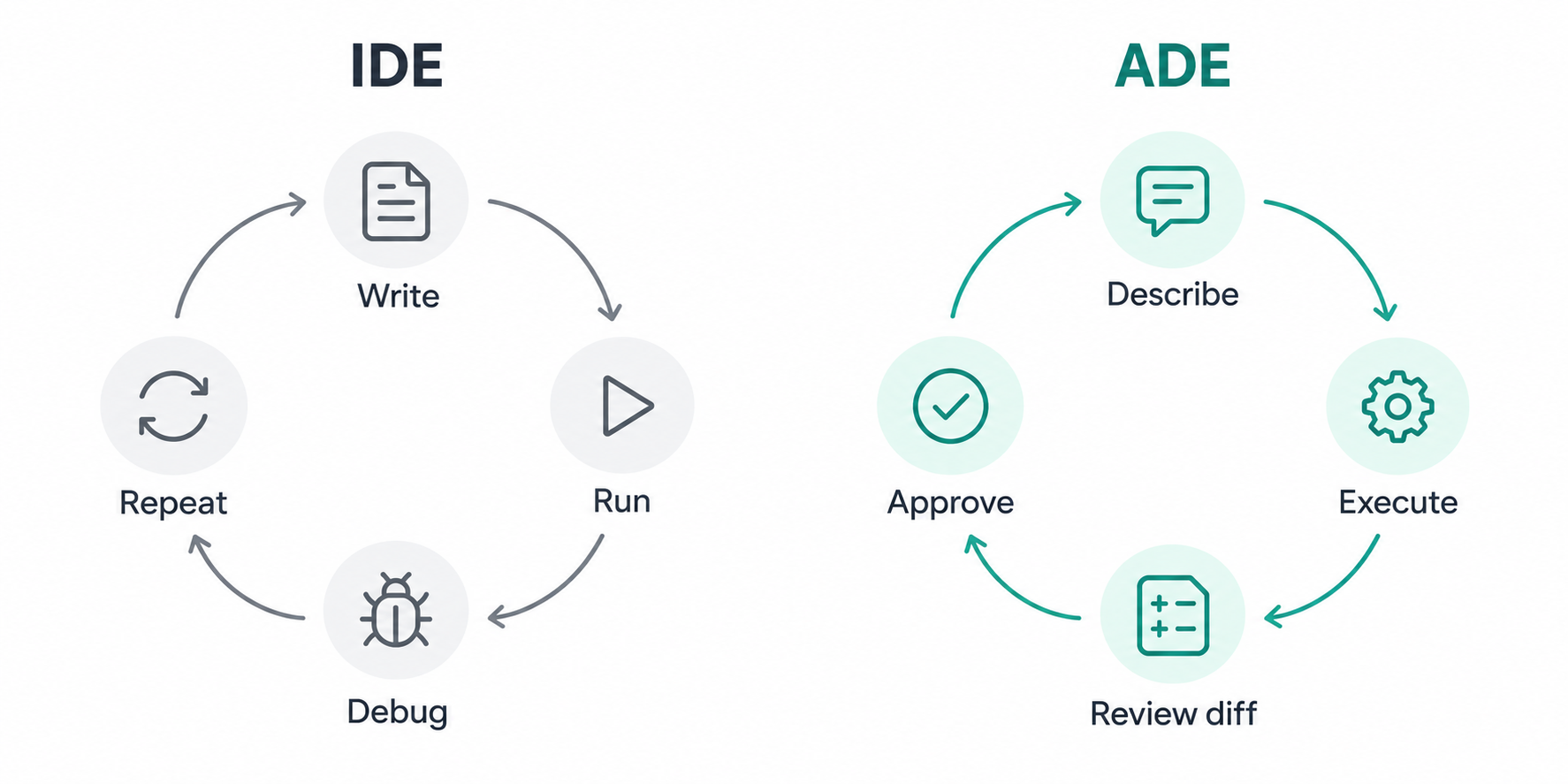
That sounds like a small reshuffle. It isn't. When you're writing every line, the editor is the main event and the AI is a helper bolted onto the side. When the agent is writing most of the lines, the editor becomes the review surface and the terminal becomes a control panel. Your attention shifts from typing to judging. From "how do I write this" to "is this the right thing, and did it do it correctly."
Warp has a line about developers becoming tech leads for a group of agents, and that matches my day better than I'd like to admit. I spend less time in the code and more time doing what a lead does: writing clear specs, reviewing output, catching the thing that technically works but misses the point.
My actual setup, and where it breaks
I'm not writing this from the sidelines. I switched to Cursor Pro for all my coding a while back, and I lean on Claude Code for the heavier agent runs. On a good day it feels like the future everyone keeps promising. I describe a feature, the agent scaffolds it across five files, I review, I nudge, it ships. Tasks that used to eat an afternoon get done before lunch.
A lot of that payoff comes from setup I never used to bother with. I keep a stack of custom instructions and reusable skill files that the agent reads before it touches anything, so it starts out knowing my conventions instead of guessing at them. That part is genuinely new work. In the old world, most of my knowledge lived in my head and in my fingers. In the ADE world, I have to write it down somewhere the agent can see it, and the quality of what comes back now tracks the quality of that written context far more than it tracks my raw typing speed.
Prompting well is the easy part. Encoding your taste so a machine can follow it is the real skill.
But I want to be straight about the parts that still don't work, because the marketing never is.
Agents are great on greenfield code and small, well-scoped changes. They get shaky the moment the context gets deep. Drop one into a large, tangled codebase with ten years of decisions baked in, and it confidently does the wrong thing with the same tone it uses when it's right. The review burden is real. Some days I spend more time reading diffs and undoing clever-but-wrong edits than I would have spent just writing the code.
I'm not alone in noticing this. Warp's own CEO admitted that most professional developers still haven't changed their core workflow, and that the people fully in on agentic tools skew toward hobbyists and early adopters. JetBrains was even blunter in its Air launch: complex codebases aren't ready for pure agentic coding yet. When the companies selling the dream are the ones telling you to slow down, it's worth listening.
So no, I haven't deleted my editor. I still drop into the file and write it myself when the task is fiddly, security-sensitive, or just faster by hand. The ADE didn't replace the IDE. It wrapped around it.
A quick warning about the acronym
If you go searching, you'll hit a confusing wall. ADE means two different things right now.
The one I've been describing is Agentic Development Environment, where you build software with the help of agents. But Letta and a few others use ADE to mean Agent Development Environment, a place to build and debug the agents themselves. Same three letters, different problem entirely. Keep them straight or you'll end up reading docs for a product that solves nothing you have.
This is what an early category looks like. Nobody agrees on the definition yet. Warp says the ADE lives in the terminal. JetBrains says it sits beside your IDE. The open-source crowd says it's a workspace that unifies every agent you already use. They can't all be right, and the fight over who defines it is still wide open.
Where I land
I think the rename is real, not hype. Not because any single tool has nailed it, but because the shape of my own work changed before any of them had a name for it. The acronym is just catching up to a thing that already happened to me.
If you're an engineer, I wouldn't throw out your habits on the strength of a blog post. But I'd get uncomfortable on purpose. Pick a real task, hand the whole thing to an agent, and force yourself to work as the reviewer instead of the author. You'll feel where it's genuinely faster and where it falls apart, and that gap is the most honest map of where this is actually going.
Twenty years from now, "I" in IDE might read like a quaint little letter. The integrated part was always about pulling your tools into one place. The agentic part is about pulling the work off your own hands. I didn't choose the moment it flipped. I just looked up one morning and realized it already had.