Three attempts. Two internships with no stipend. Zero campus placements. One GSoC selection. This is my honest account of how I cracked Google Summer of Code 2026 as an MCA student from a tier-3 college in India, without a B.Tech degree, without campus placement, and after two straight rejections
What Even Is GSoC and Why Did It Matter to Me
Before I get into the story, let me quickly explain what Google Summer of Code actually is, because when I first heard about it in 2021, I had absolutely no idea what I was looking at.
Google Summer of Code (GSoC) is a global program run by Google where students and open source beginners get paid to contribute to open source organizations over a summer. You apply to a specific organization with a project proposal, a mentor reviews it, Google funds the selected contributors, and you spend the coding period working on real software used by real people. It's not an internship at Google — the org you contribute to is what matters, not Google itself. But it is Google-backed, globally recognized, and something that genuinely opens doors.
The first time I came across GSoC was sometime in 2021 during my BCA, and I remember thinking — this is the kind of thing only IIT students get into. I bookmarked it, forgot about it, and moved on.
I was wrong about who gets in. It took me three attempts and a few years to figure that out.
The Wrong Stream, The Right Direction
I always wanted to be a software engineer — not in a vague, "I like computers" way, but in a specific, focused way that started the moment I got access to a computer in school. The problem was that in India, the path to software engineering is supposed to go through science stream in 11th, then B.Tech from a decent college, and only then does the world take you seriously as an engineer. I didn't get science stream. My 10th grade marks weren't good enough, so I ended up with commerce without maths, which in India basically means every door with the word "engineering" on it looks like it's locked from the outside.
For a while I genuinely believed the dream was over before it started, because that's what everyone around me implied — parents, relatives, people from the neighborhood. Then I found out about BCA, Bachelor in Computer Applications, which didn't require science stream to get in. Nobody told me about it. I stumbled across it myself while searching online at some point in 2019, and that one piece of information changed the whole direction.
"I walked through the only door that was open. Turns out that was enough."
So I walked through it.
BCA Years (2019 – 2022): Building Without a Map
BCA was where everything actually started taking shape, even if it didn't feel like it at the time. I started freelance technical writing with GeeksforGeeks during BCA, wrote 350+ articles over time, and eventually became a reviewer for them. By the time I graduated, I had job offers from Accenture, Infosys, and Guvi Geeks at around 5 LPA, and I joined briefly from December 2022 to February 2023. These were real offers, real companies, and for most people around me that would have been the end goal.
But FAANG was still the goal for me. Amazon specifically, because Amazon felt like the benchmark. And Amazon, like most product companies, doesn't interview BCA students for engineering roles — that's just how it works in India. The degree filter exists and it's not going away anytime soon.
So I started preparing for NIMCET, the national entrance exam for MCA, knowing it meant two more years of studying for a postgraduate degree that might actually open the doors BCA couldn't. Some people called it wasting two years. I called it building the qualification I needed.
During BCA I also started poking around open source in 2021. Got into GSSoC twice as a contributor and twice as a mentor, reviewed dozens of PRs, participated in Hacktoberfest multiple times, did Google Cloud challenges, and got selected as a Microsoft Learn Student Ambassador (now Microsoft Student Ambassadors). I also joined programs and ran sessions with college students through MLSA. None of this felt strategic at the time — I was just doing things that seemed useful and interesting, without a clear picture of where it was all going.
That's the part nobody tells you when you're starting out: you don't need to see the whole path. You just need to keep moving.
Getting Into USICT (2023): The Plan Working
I cleared NIMCET 2023 with a decent rank and got into USICT, Guru Gobind Singh Indraprastha University — one of the better MCA programs in Delhi. This was the plan working. First year, I'll be honest: I played. Spent time with friends, adjusted to the new environment, studied some coding, and generally didn't push very hard. But by the second semester I started going after bigger open source projects with more focus, partly because the GSoC application period was coming up and I'd told myself this was the year I'd seriously try.
GSoC 2024: First Attempt, First Rejection, Unexpected Turn
Towards the end of 2023 I started exploring GSoC organizations properly. I shortlisted around 6 to 8 orgs, set up 5 to 6 big projects locally to understand the codebases, and planned to apply to 3 of them. Google Chromium was one of them and I also had PRs merged in Chromium Web Audio Samples (Google Chrome Labs) around this time, which gave me some confidence that I could contribute meaningfully to large, production-grade codebases.
OTSF became the org I went deepest on. I started contributing to their documentation project first (doesn't mean README updates :) ), got some solid PRs merged, and then applied for GSoC 2024 with the Open Transit Software Foundation.
Didn't get selected :(. The project didn't receive a slot that year and the scope was too small. Clean rejection.
But Aaron at OTSF (my mentor), offered me a 3-month internship based purely on the quality of my contributions — no stipend, no GSoC badge, just real work on a real project. I took it without hesitation.
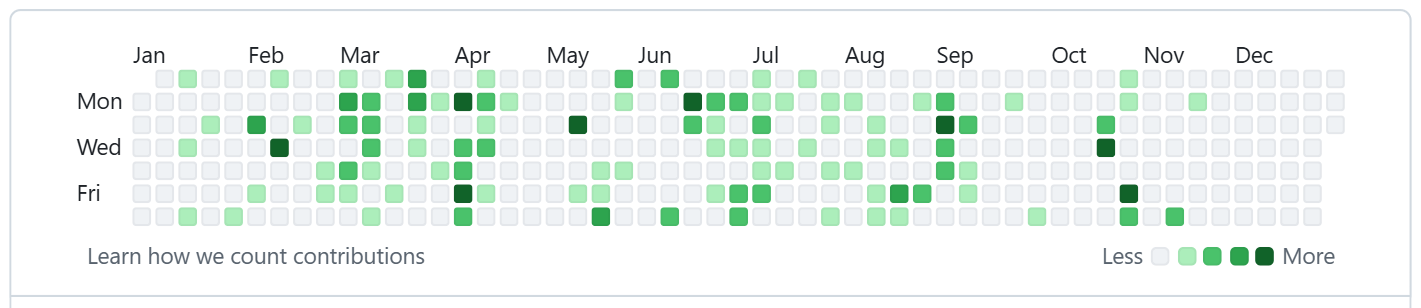 The graph might not look full, but the contributions were real
That's how I got into Wayfinder — OneBusAway's next-generation transit web app — as a founding engineer starting June 2024. Building something from the ground up, watching it go from an early prototype to a live deployment used by real riders in San Diego, was the kind of experience you can't manufacture through any internship application process. I learned real system architecture design and development from industry experts.
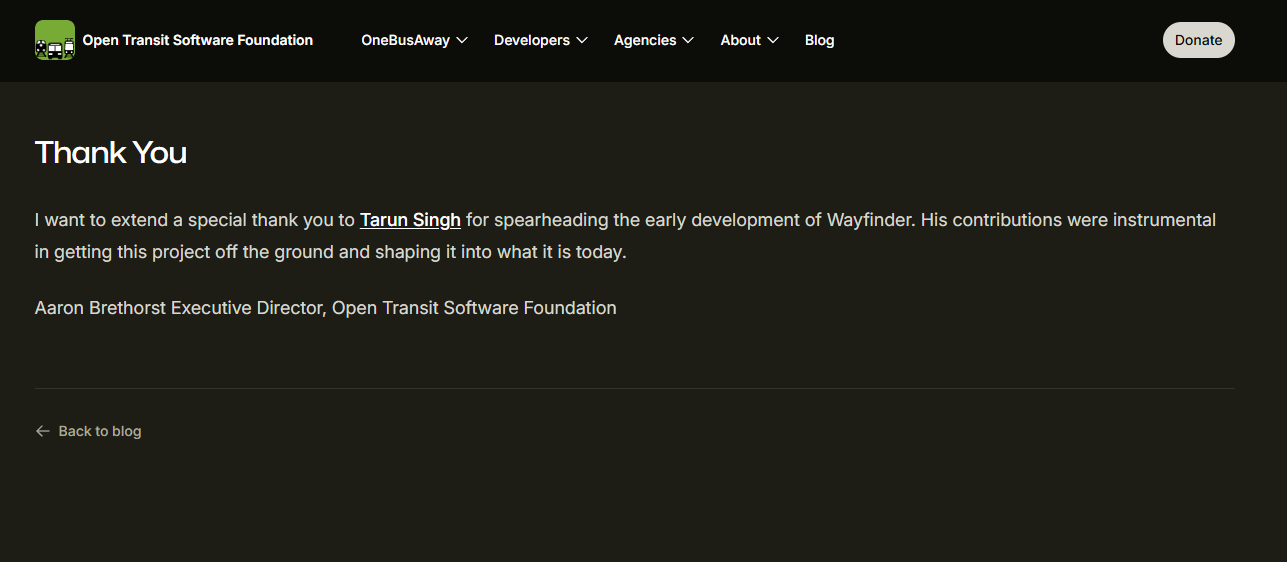 Wayfinder public launch acknowledgement
GSoC 2025: Second Attempt, Second Rejection
I applied again in 2025 with the same org, a stronger contribution history, and a better-structured proposal. Same result — no project slot.
That one hit differently than the first rejection. Two years of contributing, two rejections. I spent a few days genuinely questioning whether I was reading the situation wrong, whether I was wasting time on something that wasn't going to work out for me. I got discouraged, and I'm not going to pretend otherwise.
"I stayed active not because I had a plan, but because I genuinely cared about the project."
But I stayed active in the OTSF community anyway — kept contributing to the codebase, showing up in the Slack channel, helping newer contributors get set up. I asked my mentor about what I need to improve, where I went wrong, what else I could do. Then based on the discussions and all, I came up with a strategic plan and the organization recognized that and offered me a 1-year internship. Still unpaid, but the scope was larger and the trust behind it was real.
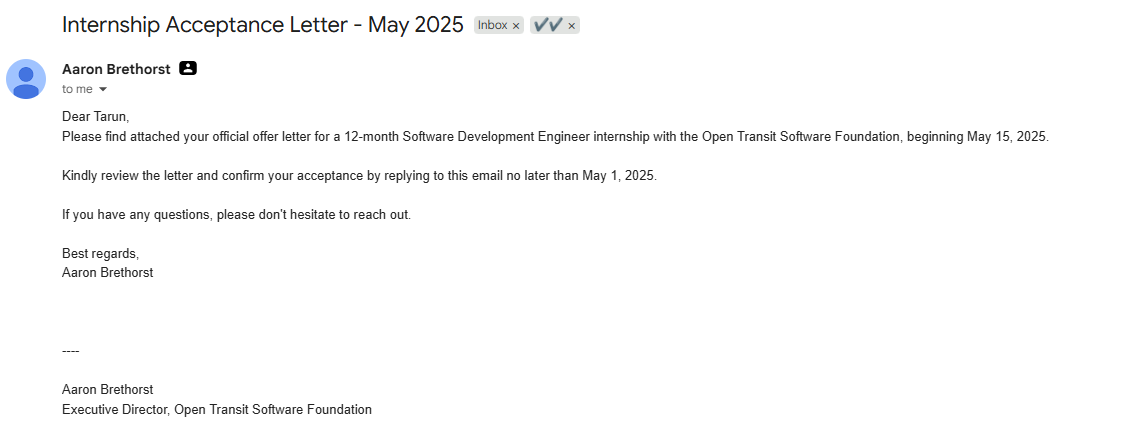 Internship offer letter with OTSF
The BCA/MCA Problem That Nobody Talks About
I want to say this plainly because I've seen too many people from similar backgrounds quietly give up without ever understanding that the system was tilted against them, not that they weren't good enough.
BCA and MCA students in India don't get the same access or exposure that B.Tech students get, and it's not because they're less capable — it's because the infrastructure around them is worse. Most BCA and MCA students don't know that programs like GSoC, LFX Mentorship, or MLH Fellowship exist until it's too late to apply, and the ones who do find out often discover they're excluded anyway because some of these programs and companies have degree requirements baked into their eligibility criteria. The bias is the same one Indian parents have about engineering degrees, just dressed up in hiring policy language.
Here's what I actually believe having gone through all of this- neither your college tag nor your course determines how far you can go in this field. What actually moves the needle is your:
- dedication to the craft
- quality of what you build
- consistency over time
- relationships you build inside technical communities
Every single thing in my story traces back to those four things, not to which university I attended or what my degree says.
GSoC 2026 Selected: Third Attempt
I applied again in 2026. Same organization, same project, but a completely different proposal — one that was grounded in a year and a half of actual hands-on codebase contributions, specific file names and functions I had personally worked with, real bugs I had found and fixed, and a plan that traced directly back to work already in progress rather than features I was guessing about.
40+ merged PRs - Aaron credited me by name in the official Wayfinder public launch blog as the person who helped get the project off the ground. I was already a current intern actively working on the codebase.
On April 30, 2026, it went official.
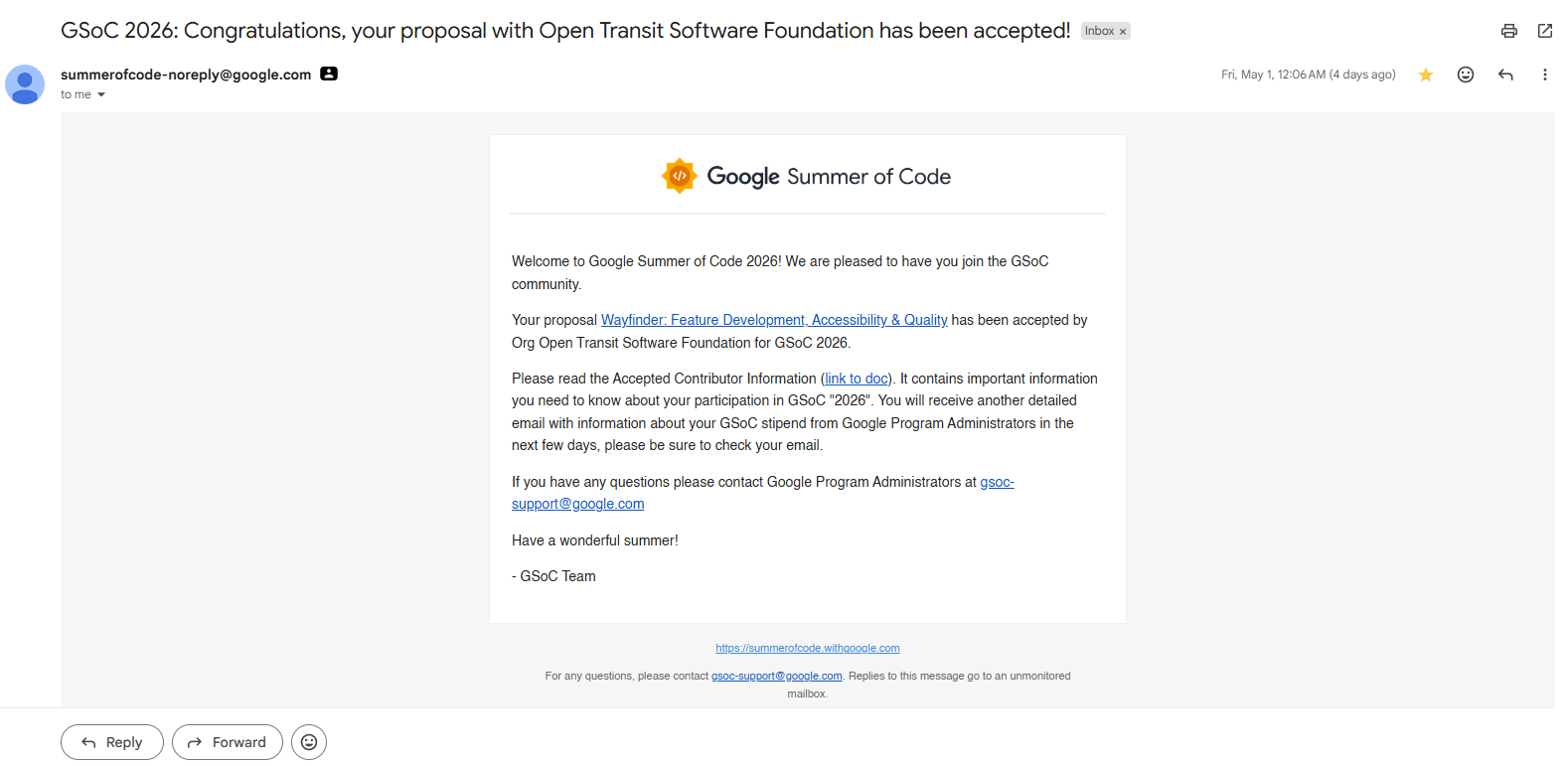
Three attempts. Two years of contributing without a slot. One plus year of unpaid internship work. It added up.
Selected for Google Summer of Code 2026 with the Open Transit Software Foundation.
What I'm Building This Summer
This summer I'll be continuing working on Wayfinder full-time as part of GSoC — feature development covering favorites and bookmarks for stops and routes, smarter service alerts with route and stop filtering, live arrival updates with intelligent polling, and shareable stop and trip URLs. On top of that, a full WCAG 2.2 accessibility audit with prioritized fixes, and migrating the codebase from Tailwind v3 to v4 and Flowbite to shadcn-svelte.
Real software used by real riders in San Diego right now. That part still blows my mind every time I think about it.
How to Crack GSoC — GSoC Proposal Tips That Actually Worked
A lot of GSoC advice online is vague. Here's what actually worked, specific and honest:
First — Start at least 4 to 5 months before the application period opens. Organizations notice contributors who show up consistently over time, not people who appear two weeks before the deadline with a flurry of PRs. The GSoC application period for 2026 opened in March. I started contributing to OTSF in late 2023. By the time I submitted my proposal, my contribution history was the proposal. Use the months before applications open to actually understand the codebase, find real issues, and build genuine familiarity with how the project works.
Second — Build real relationships with mentors and org admins. This doesn't mean spamming them with questions or trying to manufacture a friendship. It means showing up in the community channels — Slack, Discord, GitHub discussions, mailing lists — asking thoughtful questions, helping other contributors when you can, and letting your work speak before you speak about your work. Mentors and admins notice the people who contribute to the community beyond just writing code. Aaron noticed me not just because of my PRs but because I was active in Slack, helping new contributors get set up, and showing genuine investment in the project's success.
Third — Submit meaningful PRs only. No spam, no README edits, no trivial fixes padded to look like contributions. Organizations have seen every version of contribution padding and they're not impressed by it. One PR that fixes a real bug or adds a real feature is worth more than fifteen PRs that change whitespace or update a comment. Go deep on one thing rather than spreading thin across many things. Note: Please don't use AI tools to generate PRs and all, as mentors can flag you for this such act.
Fourth — Write your proposal based on direct input from your mentor, and only promise what you can actually deliver. The biggest mistake GSoC applicants make is writing a proposal based on what they think sounds impressive rather than what they actually understand and can build. My 2026 proposal (attached below) worked because every feature I proposed traced back to a specific file or function I had already read, a real gap I had confirmed existed in the codebase, and an approach I had already discussed with Aaron. If a mentor tells you something during your conversations, put it in the proposal. If you haven't talked to your mentor about your proposal before submitting it, you're missing the most important feedback loop available to you.
My 2026 GSoC proposal (which got selected) is as follows: GSoC proposal
The most important advice I can give you, and I mean this genuinely: even if you don't get selected in GSoC, keep contributing to the project anyway. Your consistency will get noticed. You might get an internship like I did, or eventually a full-time role, or you might even become a GSoC mentor yourself one day without ever having been a GSoC contributor (as I have seen people do). The selection is not the only outcome that matters. The relationships and the work you build along the way are real regardless of whether Google puts a stamp on it.
You Can Do This Too — Seriously
If you're a BCA or MCA student reading this, or a B.Tech student from a tier-2 or tier-3 college feeling like the doors are closed to you — I want to be direct with you. Neither your college name nor your degree type is what determines whether you can get into programs like this. What determines it is whether you actually show up, do the work, build relationships, and stay consistent long enough for it to matter.
I graduated from USICT, a good university but not an IIT, with an MCA in Software Engineering (which is similar to CSE) degree that many companies and programs don't even accept as a qualifying credential. I didn't get placed on campus. I ran out of the typical pathways available to most CS students. And I still got here.
The system is biased honestly and that's real and I'm not pretending otherwise. But the bias is not absolute, and open source is one of the most genuinely meritocratic spaces I've found in tech because your code, your communication, and your consistency are visible to anyone who wants to look regardless of what your degree says.
If I could do it, so can you. Just start earlier than I did.
What I'd Tell My 2023 Self
Keep contributing even when there's no slot and no stipend and no visible reward for it. The work you do without any guarantee of recognition is the work that actually builds something lasting, because it's the only work that's genuinely yours.
Find the doors that are open, walk through them, and then keep building from wherever you land :)
I offer personalized mentorship to students who want to get into open source and GSoC. If you're interested, you can book a slot here: topmate.io/tarunsingh24
Also, you can connect with me over LinkedIn or X.
Har Har Mahadev. 🙏
Frequently Asked Questions
Can MCA students apply for GSoC? Yes. GSoC is open to anyone 18 or older who is a student or was enrolled in an academic program within the past year. Your degree type does not matter. I got selected as an MCA student from a tier-3 college.
How many months before should I start contributing for GSoC? At least 4 to 5 months before the application period opens. For GSoC 2026, applications opened in March. I started contributing to my org in late 2023.
Do you need to know the org's tech stack before contributing? Not fully, but you need to be willing to learn it fast. I learned SvelteKit from scratch within two weeks of joining Wayfinder and became the primary frontend contributor.
Is it necessary to interact with mentors before submitting a proposal? It's not required but it's the single biggest factor in whether your proposal gets selected. My proposal worked because every section of it reflected conversations I had already had with my mentor.
What if I don't get selected in GSoC? Keep contributing anyway. I contributed for two full years without a slot and ended up with a year-long internship and eventually the GSoC selection. The work doesn't stop mattering just because Google didn't stamp it.